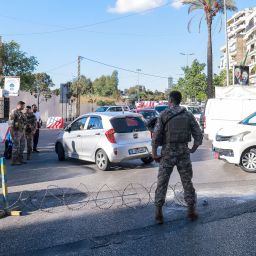
Live Updates Exploding pagers injure hundreds in Lebanon
[2]
Live Updates Sean ‘Diddy’ Combs indicted on federal charges
[4]
Live Updates 2024 campaign and apparent Trump assassination attempt
[6]- Scores injured: At least eight people were killed and 2,800 wounded[7] in an attack that targeted pagers[8] held by members of Iran-backed Lebanese militant group Hezbollah across Lebanon on Tuesday, according to the country’s health minister. Iran’s ambassador to Lebanon[9] was one of those injured, according to Iranian state media.
- Warnings on pagers issued: Lebanon’s health ministry has urged citizens who possess pagers to discard them and warned hospitals to be on high alert.
- Where the blasts happened: Explosions reportedly occurred[10] in a southern suburb of Beirut known as Dahiyeh, and other towns in central and southern Lebanon.
- No comment from IDF: The Israeli military, which has engaged in tit-for-tat strikes with Hezbollah for months, said it would not be commenting[11] on the incidents.
13 Posts
The pager explosions have left Hezbollah with few good options in its conflict with Israel, says Maha Yahya, director of the Carnegie Middle East Center in Beirut.
Although Israel has not commented on the explosions, Hezbollah and the Lebanese government have said they hold Israel responsible.
“They’ve lost the deterrence – they haven’t lost it completely, but they’ve been hemorrhaging, if you like, a lot of their deterrence,” she added.
Yahya said how Hezbollah responds to the explosions could be influenced by Israel’s next move.
Hezbollah has placed responsibility for the deadly pager explosions in Lebanon on Israel, and vowed retribution.
“This criminal and treacherous enemy will definitely receive a fair punishment for this sinful assault, both in ways that are expected and unexpected,” Hezbollah added.
The Israeli military, which has engaged in tit-for-tat strikes with Hezbollah for months, said it would not be commenting on the incident.
At least 170 people injured in the explosions in Lebanon are in critical condition, Lebanese Health Minister Firass Abiad said in an interview with Al Jazeera.
The majority of those injuries are in the abdomen, hand and face, particularly in the eye area, he said earlier at a news conference in Beirut.
Abiad added that many hospitals in the southern Lebanon have exceeded capacity due to the sheer number of injured people arriving. More than 100 hospitals in Lebanon – largely in the southern suburbs of Beirut, southern Lebanon and the Beqaa valley – received injured people.
Earlier on Tuesday, the Lebanese Ministry of Health called for health workers to urgently report to work given the “large number of injured people being transferred to hospitals” following the pager explosions. Officials have also called for people to donate blood in anticipation of increased need.
Seth Jones, the director for the Center for Strategic and International Studies’ International Security Program, told CNN that Hezbollah will “have to respond” to Tuesday’s pager explosions in Lebanon.
“Now that we’re seeing Israel start to wrap up the war in Gaza, they are starting to turn north,” he said. “Israel is really trying to change the situation on the ground and create some sense of security on its northern border.”
Although Hezbollah’s response to the Israeli assassination of the senior Hezbollah commander Fuad Shukr in a Beirut suburb in July was “relatively muted,” Jones said Hezbollah will now have no choice but to retaliate.
The Israel Defense Forces (IDF) has previously estimated[12] that Hezbollah has approximately 150,000 rockets and missiles, including thousands of precision munitions.
At least nine people, including an 8-year-old girl, have been killed by Tuesday’s pager explosions, Lebanon’s health minister Firass Abiad said in an interview with Al Jazeera.
Some 2,800 others have been injured in the incidents, Abiad added.
This post has been updated with the number of deaths.
The pager explosions come after Israel’s security cabinet voted Monday to add another war objective[13] to its ongoing conflict with Hamas and Hezbollah: ensuring the safe return of residents from communities along its border with Lebanon to its homes.
After nearly a year of cross-border exchanges between Hezbollah and Israel, tens of thousands of people have been displaced from their homes in southern Lebanon and northern Israel.
While the return of residents of northern Israel has long been understood to be a political necessity for Netanyahu’s government, this is the first time it has been made an official war goal.
Before Monday’s vote, Netanyahu had said it won’t be possible to return residents to the north without a “fundamental change in the security situation” along the border, his office said.
He added that Israel will “do what is necessary” to return residents to their homes.
Defense Minister Yoav Gallant was more explicit, saying the only way to allow the residents to return home is “through military action.”
Israel’s military has not yet commented on Tuesday’s explosions.
The pager explosion incident in Lebanon on Tuesday killed three people, including a child and two members of the militant group, Hezbollah said on its Telegram channel on Tuesday.
The explosions occurred around 3:30 p.m. local time and impacted “workers” in various Hezbollah institutions, the group said, adding that a “large number” of people were injured.
Hezbollah said its security apparatus has launched an investigation into the incident, stopping short of blaming any party for it.
Iran’s ambassador to Lebanon, Mojtaba Amani, was injured in a pager explosion on Tuesday in Beirut, according to Iranian state media IRNA.
Amani has a superficial injury and is currently under observation in the hospital, IRNA reported, citing his wife.
Two employees of the Iranian embassy were also injured, according to Iran’s semi-official Fars news agency.
The explosions impacted several areas in Lebanon, particularly the southern suburbs of Beirut, according to Lebanon’s Internal Security Forces.
Explosions reportedly occurred in:
- the southern suburb of Beirut, known as Dahiyeh
- in the towns of Ali Al-Nahri and Riyaq in Lebanon’s central Beqaa valley
- and in Sidon and Tyre in southern Lebanon.
View a map of the wider region here:
Footage shared online shows people in Lebanon going about their days before their pagers exploded.
In one video, a man is seen shopping in a fruit and vegetable market before an object explodes from his midriff. The man collapses to the ground and cries out in pain, while other bystanders scatter in fear.
In another, security camera footage shows a man about to pay for goods at a store before something on his person explodes, sending a burst of smoke into the air.
In another, a person films the damage inside a bedroom after an apparent explosion. Two holes have been torn through the top and bottom of a drawer, smashing a nearby mirror and scattering debris across the room.
CNN has not been able to independently verify the videos.
The Israel Defense Forces (IDF) has said it will not be commenting on the reported explosions in Lebanon.
Since war broke out between Israel and Hamas in Gaza on October 7, there have been almost daily exchanges of fire across the Israel-Lebanon border.
Health workers across Lebanon are being asked to report to work given the “large number of injured people being transferred to hospitals” following Tuesday’s pager explosions, Lebanon’s Ministry of Health said.
Officials have also called for people to donate blood in anticipation of increased need.
Hundreds of people in Lebanon have been injured in an attack targeting the pagers of Hezbollah members, a Lebanese security source told CNN Tuesday.
We’ll bring you more on this breaking story as we get it.
Ad Feedback
Ad Feedback
Ad Feedback
Read more https://packetstormsecurity.com/news/view/36347/Wait...-Did-Pagers-Get-Hacked-To-Blow-People-Up.html

