Industrial cybersecurity company Dragos on Tuesday
published its ICS/OT Cybersecurity Year in Review report for 2022,
sharing details on state-sponsored attacks and malware, as well as
ransomware and vulnerabilities.
When it comes to malware designed specifically to target
industrial control systems (ICS), the discovery of Pipedream/Incontroller is the most
significant event. This ICS attack framework, linked to Russia and
aimed at energy facilities, has the capabilities to impact tens of
thousands of industrial systems that control critical
infrastructure.
In addition, the existence of Industroyer2 came to
light last year. The malware, used in an attack aimed at an energy
provider in Ukraine, is designed to cause damage by manipulating
ICS.
In total, seven pieces of ICS malware have been discovered to
date, including Stuxnet, Havex, BlackEnergy2, CrashOverride, and
Trisis.
In addition to new malware, 2022 saw two threat actors being
added to the list of groups targeting industrial organizations:
Chernovite, which is the developer of Pipedream, and Bentonite, an
Iran-linked actor
that opportunistically targeted maritime oil and gas, government
and manufacturing organizations for espionage and disruption.
Dragos has been tracking 20 threat groups that have targeted
industrial organizations, eight of which were active in
2022.
When Russia launched its invasion of Ukraine, Dragos predicted
that there would be an increase in attacks targeting operational
technology (OT) systems at US organizations in the energy
sector.
However, Dragos admitted in its report that it saw
fewer-than-expected attacks against this sector, and it’s not aware
of any successful ICS-focused attacks on US energy entities.
[ Read: Cyber Insights
2023 | ICS and Operational Technology
]
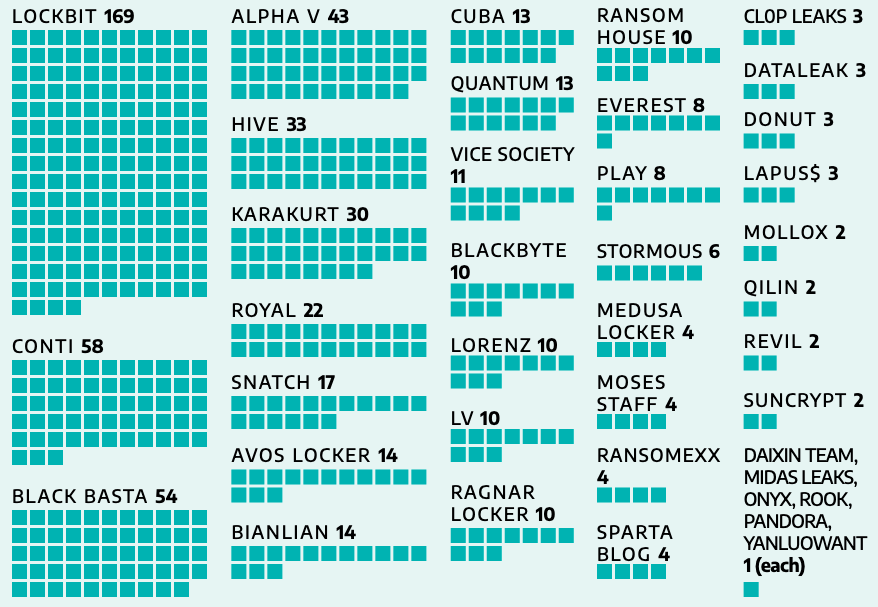
On the other hand, ransomware attacks surged last year. Dragos
tracked more than 600 attacks against industrial organizations,
which represents an 87% increase compared to the previous
year.
The company has been tracking a total of 57 groups, including 39
that were active in 2022, 30% more than in 2021.
More than 70% of the attacks observed last year were aimed at
organizations in the manufacturing sector (437 attacks), followed
by the food and beverage industry (52 attacks), energy (29),
pharmaceuticals (27), and oil and gas (21).
The most targeted manufacturing subsectors were metal products,
automotive, electronics, building materials, industrial equipment
and supplies, and plastics.
The LockBit group was responsible for 28% of all attacks
recorded last year, followed at a significant distance by Conti,
which shut down operations
in May, and Black
Basta.