GootLoader was born from GootKit, a banking trojan that first
appeared around 2014. In recent years GootKit has evolved into a
sophisticated and evasive loader — and it was given a new name to
reflect its new purpose in 2021. The same group is responsible for
both versions of the malware, and is monitored by Mandiant as
UNC2565.
The evolution of GootLoader reflects the evolution of
cybercriminal gangs. Many of the more sophisticated gangs are
switching to a malware-as-a-service business model. They develop
the malware, but less-advanced gangs or individuals pay for use of
that malware. In this case, it is access (or victim) as a service.
GootLoader provides access to victims primarily for ransomware. The
access is likely taken up by ransomware-as-a-service (RaaS) groups
who sell-on the access to ransomware groups or individual
criminals. For further details on this business model, see Cyber
Insights 2023: Criminal Gangs.
GootLoader continues to evolve. Researchers at Cybereason have
published a deep dive into the
latest version.
The infection journey starts within compromised WordPress sites.
These sites are given greater validity through SEO poisoning
techniques, with key words likely hidden within html code on valid
pages. Google Ads may also be used. With a high search engine
ranking, potential victims are more likely to visit the compromised
site.
The primary targets are healthcare and finance within English
speaking countries, such as the US, the UK and Australia.
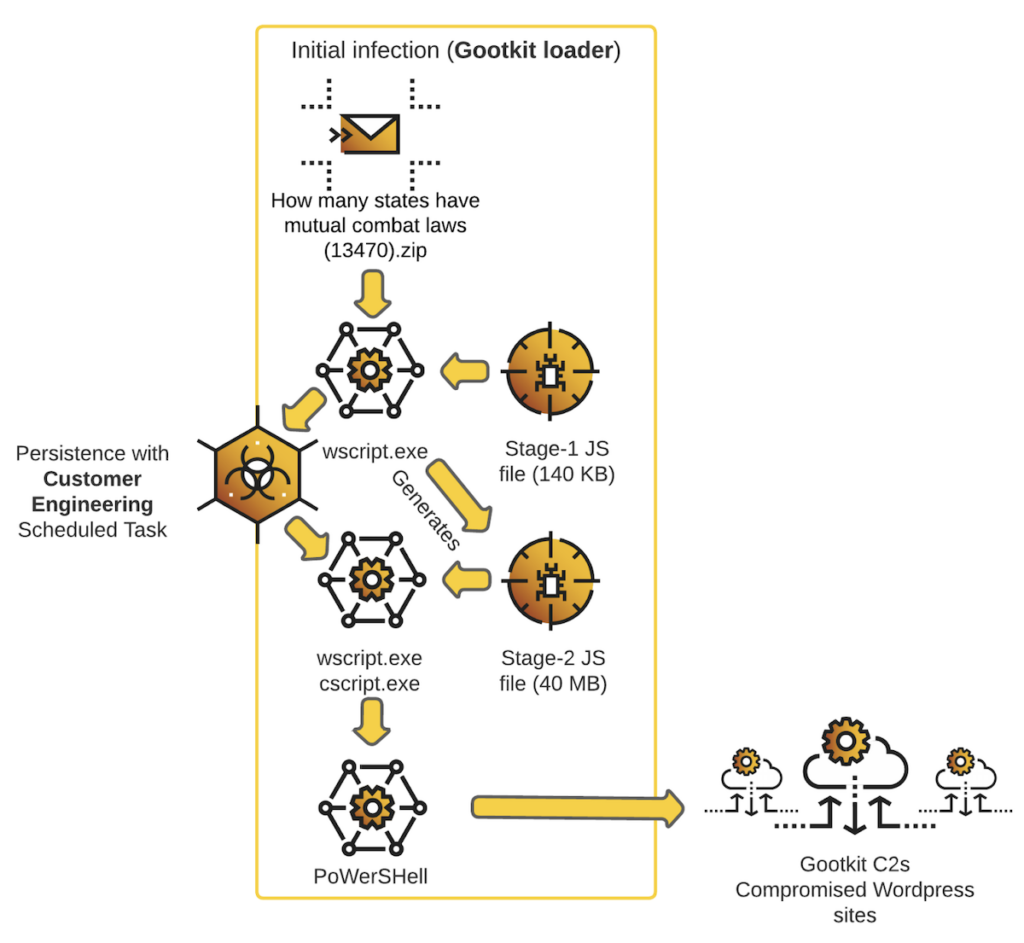
If a victim is drawn into a watering hole WordPress site, he is
provided with a ZIP file containing a malicious JavaScript. This is
described as stage-1 of the GootLoader infection. The JavaScript
establishes persistence by creating and running a ‘Customer
Engineering’ scheduled task. It also generates a second JavaScript
file (stage-2 of the infection) which is 40 MB in size (random junk
code is added, probably to confuse and evade detection).
The Customer Engineering task has been configured to execute
this large new JavaScript file. It ultimately provides PowerShell
code, which executes a command and control function every 20
seconds using random GootLoader C2 URLs as parameters. It uses
system discovery calls to obtain the environment variables,
processes, desktop items and disks on the victim machine. This data
is compressed, and encoded, and sent to the C2 disguised as a
cookie.
As an aside, the researchers used ChatGPT to make some of the PowerShell code
more easily understood. It was used, for example, to change the
original variable names into more descriptively pertinent names.
This it did effectively, but researcher Loic Castel told
SecurityWeek that ChatGPT’s value to seasoned researchers
is limited. “It cannot help with the more complex work – couldn’t
help with the de-obfuscation – but it may be used by junior
researchers in more basic stages.”
Lateral movement starts with disabling Microsoft Defender, and
proceeds with Cobalt Strike loaded through DLL hijacking. SystemBC
is deployed.
Cybereason was unable to see the final effect of GootLoader. The
instance comes from its own telemetry where it detected and stopped
GootLoader’s progress. The final malware deployment didn’t happen.
But they did detect the deployment of SystemBC.
“SystemBC is what we call the precursor of ransomware,”
explained Castel. “We often see it hours, maybe days, before the
ransomware is actually deployed. This is something that is often
deployed just before a ransomware attack.”
Any subsequent ransomware attack would almost certainly not have
been delivered by UNC2565. Their function within the modern
criminal ecosphere is to provide access to victims, and to sell
that access to other criminals. The final payload is not
pre-defined, but it seems likely to be particularly relevant for
ransomware.
GootLoader is not a specifically targeted attack. However, some
generalized targeting is achieved through the development of the
original watering hole process. This suggests that this instance of
the malware is aimed at the healthcare and finance sectors within
English-speaking countries.
Cybereason assesses the GootLoader threat level as ‘severe’. The
malware uses a combination of evasion and living off the land
techniques, and its presence is unlikely to be spotted by anything
other than AI-assisted anomaly detection.
Related: Ransomware, Malware-as-a-Service Dominate Threat
Landscape
Related: Recent GootLoader Campaign Targets Law, Accounting
Firms
Related: Mouseover Macro Campaign Delivers Gootkit Trojan
Via PowerPoint
Related: GootKit Trojan Targets Banks With Redirection
Attacks