Research-focused security services provider IOActive has
conducted an analysis of car vulnerability trends over the past
decade and determined that the automotive industry has been placing
increasing importance on cybersecurity.
The new IOActive automotive cybersecurity study (PDF) looks at
vulnerabilities discovered over the last 10 years, with a focus on
trends between 2016, 2018 and 2022.
The company has ranked and grouped vulnerabilities based on
their potential real-world impact, their likelihood of
exploitation, and their overall risk, with this risk level being
calculated based on impact and likelihood.
In terms of impact, the percentage of car vulnerabilities with a
critical rating went from 25% of the total in 2016, to 10% in 2018,
and 12% in 2022. High-impact flaws gradually decreased from 25% to
21% between 2016 and last year.
However, over the past 10 years, the percentage of critical
issues dropped by 13% and high-impact issues by 4%.
In terms of likelihood of exploitation, critical vulnerabilities
went from 7% of the total in 2016 to 1% in 2022. High-likelihood
issues dropped to 16% in 2022, from 21% in 2016. This, according to
IOActive, suggests that vulnerabilities are becoming more difficult
to exploit or “the vectors to discover vulnerabilities are becoming
less remote”.
“In cybersecurity parlance, there is less ‘low-hanging fruit,’
indicating that between 2018 and 2022, the automotive industry
learned from its initial mistakes and is building better,” the
cybersecurity firm said.
Overall, the percentage of critical- and high-likelihood
vulnerabilities decreased by 6% and 5%, respectively, in the past
10 years.
When it comes to the overall risk, the percentage of high-risk
vulnerabilities has increased by 3% and medium-risk issues by 25%
in the past 10 years, but critical-risk weaknesses decreased by 17%
over the same period.
The ‘critical risk’ rating is assigned to issues that can be
exploited remotely and are easy to discover, with impact including
complete component compromise or safety concerns. High-risk flaws
are ones that can be exploited from nearby or require limited
skills, and their impact includes partial component control,
sensitive information disclosure or a potential safety concern.
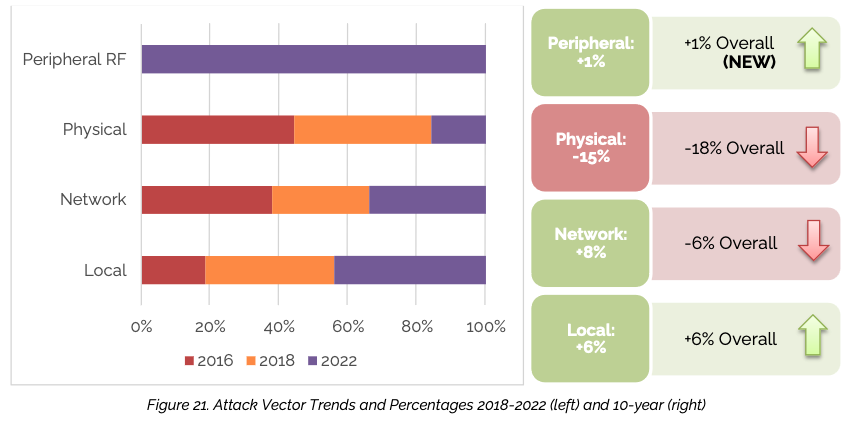
As for attack vectors, physical hardware attacks dropped from
28% in 2016 to 10% in 2022, but local and networked attack vectors
have increased. IOActive has also seen a slight but important rise
— from 0% to 1% — in radio frequency attacks, particularly remote
keyless entry and Bluetooth attacks.