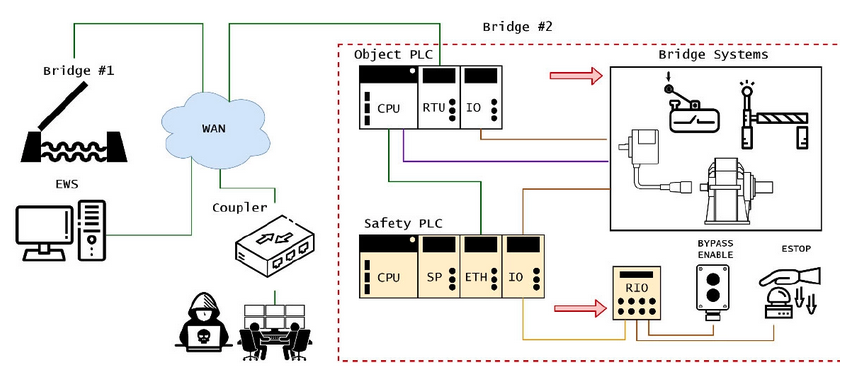
The attack scenario, described in detail in a research paper published this week, involves an attacker first exploiting a vulnerability in a Wago coupler to enable communications with a Modicon PLC. The attacker then bypasses the UMAS service authentication on the PLC and achieves remote code execution on the PLC in an effort to move to the bridge control system’s internals.
From there, the hacker can manipulate field devices connected to the controller. Before they can attempt to cause any physical damage, the threat actor also exploits a remote code execution vulnerability in an Allen Bradley safety controller that is designed to prevent accidents.
The attack method is stealthy, allowing the hacker to conduct a wide range of malicious activities without raising suspicion.

As for the real-world impact of such a hack, in the case of the bridge scenario described by Forescout, an attacker could leverage their access to tamper with the lock bar in order to cause the bridge to become blocked in a partially open position.
The attacker could also cause the bridge to close at full speed (without decelerating before it’s fully closed), or initiate a closing sequence and triggering an emergency stop when the bridge leaf is at maximum velocity. Both can cause significant damage to the structure.
Related: 2022 ICS Attacks: Fewer-Than-Expected on US Energy Sector, But Ransomware Surged
Related: Hackers Can Exploit GE Historian Vulnerabilities for ICS Espionage, Disruption

