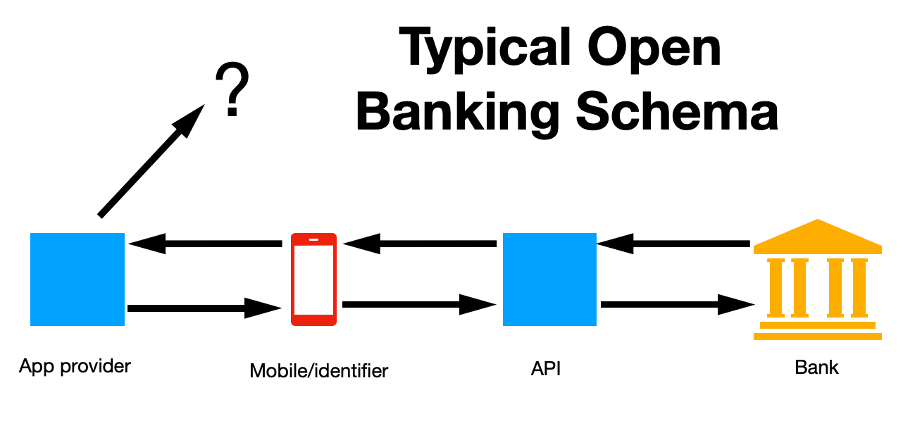
Lebin Cheng, VP for API Security at Imperva provides an overview of a market where traditional communication is from one walled garden to another. “The bank itself can be considered a walled garden,” he told SecurityWeek, but that epithet can no longer be applied to mobile phones. “Open banking requires the bank to communicate with a mesh of services with no fixed location and where security is managed by the user. The app itself may come from a startup of just 20 people with a new AI algorithm. The promise is alluring to the user, offering better mortgage, portfolio, or debt management, but with no specific open banking regulations. And the bank itself has little control over any security but its own.”
The two primary threats within the open banking ecosphere are financial fraud (if the app itself is compromised, or if an attacker can gain control of the mobile phone and thus the API identifier), and non-consensual use of PII (through the possible resale of personal information to third parties).

APIs
“Open banking services are built on APIs,” comments Michelle McLean, VP at Salt Security; “and each single transaction can trigger dozens to hundreds of separate API calls to complete. A further complication is that these transactions involve multiple parties – the consumer’s financial institution will be exchanging data with a large number of suppliers, partners, and other consumers as part of the transaction. The scope of API calls as well as the variety of entities and interconnection points all contribute to a significant API attack surface.”
It is, she continued, an example of problems with API security, and the relevance of API security to open banking. “Unfortunately, open banking is also a great example of why APIs are such an attractive target for bad actors – the highly lucrative financial data APIs transport in open banking applications make them worth the time to look for business logic flaws.”
| Learn
More about API Security at SecurityWeek’s Cloud &
Data Security Summit As CISOs and corporate defenders grapple with the intricacies of securing sensitive data passing through multi-cloud deployments and APIs, the importance of frameworks, tools, controls and design models have surfaced to the front burner.
|

In this area, we have a new looming threat: the application of
large language model AI (such as ChatGPT) to help find those logic
flaws. Alex Polyakov, CEO and co-founder at Adversa AI sees two
threats to APIs from artificial intelligence. “Fuzzing is still one
of the best ways to find vulnerabilities in a black box
configuration, and GPT models are very good at fuzzing,” he told
SecurityWeek.
The second threat he believes will be more dangerous when open
banking APIs have AI as a backend. In this case AI jailbreak
methods will abuse the functionality of the open banking business
logic.
“While the first threat of using AI for finding new vulnerabilities in APIs seems dangerous, fortunately, we already have detection measures against those attacks –there will just be more of them,” he continued. “But the second threat is more dangerous because companies don’t have measures to prevent attacks on AI.”
Fraud
In most cases, open banking is accessed via an app on a mobile phone calling an API. At the center of its security, the API focuses on the authentication and authorization of the calling device. This is the mobile phone which is assumed to be operated by the authorized open banking customer.
But, comments Krishna Vishnubhotla, VP of product strategy at
Zimperium, “When these APIs are called from mobile apps, the risk
of abuse increases exponentially since it is easy to impersonate a
legitimate API call using a fake app and mobile device
emulator.”
Consequently, user identity will have difficulty distinguishing
between legitimate and fraudulent API calls. “Verifying identity
through an app is extremely risky,” he continued, “if there is no
confidence in the underlying device. Providers must consider mobile
device attestation in addition to API security to prevent fraud on
mobile devices.”
Privacy issues
Privacy concerns in open banking revolve around the amount and detail of PII that can move from the bank to the TPP. Selling PII is a common business plan for many service and app providers; but the user may not be aware of it.
“‘Consent’ isn’t the real privacy issue,” said Vishnubhotla; “it’s ‘informed consent’.” Consumers just don’t read fine print anymore, and it’s impossible to expect them to since it’s pages of detailed information that no one understands.

“EULAs are not written or presented with the consumer in mind,” he continued “They are also presented when the consumer is eager to see the final product offer. As a result, the user is motivated to click agree, and move on. It is important to make this information easily accessible and understandable for consumers.”
Ensuing problems, says Michael Covington, VP of strategy at Jamf, “could include financial profiles on individuals being leaked or misused to target them for unnecessary services.”
Improving the security of open banking
The open banking market is a prime target for criminals. “With the wealth of data available within the system, attackers could pursue personal information that could be used to target individuals,” said Covington. “Or they could be looking to skim off the top of the millions of transactions that would be performed within the system each day.”
He suggests regulations are the key to improving security. “Regulations will go a long way to ensure that consumer data is protected within an open banking system and that thoughtful guidelines are in place for securing the firms and their connected infrastructure. In addition, a culture of transparency will encourage firms to share details on attacks when they occur so best practices can be established, and threat intelligence shared within those participating in the platform.”
McLean believes improved visibility is important. “Breaches can be devastating for open banking businesses,” she told SecurityWeek. “To eliminate blind spots and defend against threats, open banking providers require real-time visibility into all their APIs and attack surface. Some of these organizations are rolling out new APIs almost daily, and existing APIs are changing all the time as well. So, banks need an accurate inventory of their API assets to be able to protect them.”
But identifying and stopping attacks is also necessary. This is difficult because they can unfold slowly over time – sometimes weeks or even months – and requires a large data set and continuous monitoring.
“Analyzing this extensive data set requires AI and ML – humans could never keep up,” she continued. “Open banking organizations need to be able to accurately identify malicious user intent, so API security platforms need to distill anomalies from ‘normal’ API traffic and then surface which of the anomalies are malicious.”
Open banking can be described as a perfect storm for cybersecurity. At one end, small startups with financial acumen but little or no security expertise or resources, are rushing new products to market. Banks are being forced by market pressure to join the rush, but have no specific regulatory guidance in the US on how to do so. In the middle is the user with a history of lax security habits and a mobile phone that is frequently lost, stolen, hijacked or SIM-swapped. And it’s all glued together by APIs that comprise one of the most attacked vectors in the cybersecurity ecosphere.
Related: T-Mobile Says Hackers Used API to Steal Data on 37
Million Accounts
Related: Credential Leakage Fueling Rise in API
Breaches
Related: Google Fi Data Breach Reportedly Led to SIM
Swapping
Related: PSD2 and Open Banking Bring Problems and
Opportunities for Global Banks
Related: ChatGPT, the AI Revolution, and the Security,
Privacy and Ethical Implications

