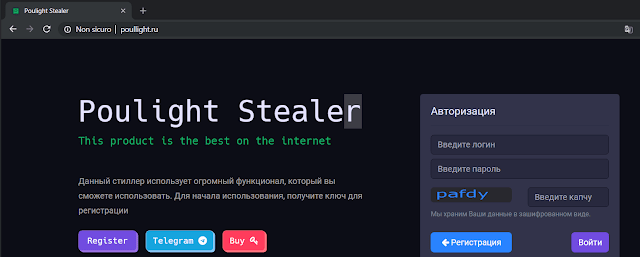
In times where info-stealer is progressively becoming one of
the most common threats, the Infostealer market has thus risen as
one of the most lucrative for cyber crooks, for the data gathered
from infected frameworks could be 'resold' in the cybercrime
underground or utilized for credential stuffing attacks.
This class of malware is said to incorporate many well-known
malware like Azorult, Tesla, and Hawkeye.
Recently over the two months, Researchers from Cybaze-Yoroi ZLab
observed the evolution and the diffusion of an info stealer dubbed
as Poulight that most probably has a Russian origin. First spotted
by MalwareBytes specialists in middle March and indicators of
compromise have been as of now shared among the security
community.
The vindictive code has propelled further stealing capabilities
and continues to evolve.
Hash
8ef7b98e2fc129f59dd8f23d324df1f92277fcc16da362918655a1115c74ab95
Threat
Poulight
Stealer
Brief Description
Poulight Stealer
Ssdeep
1536:GJv5McKmdnrc4TXNGx1vZD8qlCGrUZ5Bx5M9D7wOHUN4ZKNJH:
GJeunoMXNQC+E5B/MuO0Ogt
Above is the sample information / Technical Analysis
Like a large portion of the malware of this particular family,
it is created from a builder accessible to cyber-criminal groups
that offer a 'subscription plan' for its "product". The outcome is
a .NET executable:
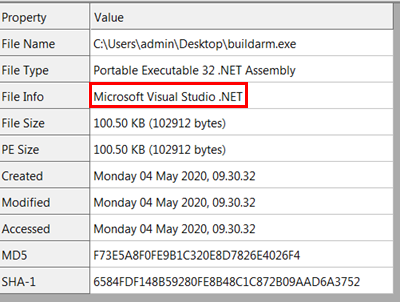 |
| Static information about the binary
file |
A quirk of this sample is that it doesn't have a minimal indication
of obscurity; the analysis is very simple to depict the malware
abilities/capabilities. When the malware is propelled, it plays out
a classical evasion technique (as shown in Fig.3):
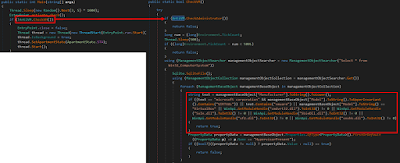 |
| Figure 3: Evasion Technique |
This implemented evasion technique is one of the most exemplary
ones, where, through the utilization of Windows Management
Instrumentation (WMI) by executing the inquiry "Select * from
Win32_ComputerSystem". Specifically, along these lines, a few
checks of the most relevant tracks of virtualization are given,
as:
• “vmware”
• “VIRTUAL”
• “VirtualBox”
• “sbiedll.dll” (Sandboxie)
• “snxhk.dll” (Avast sandbox)
• “SxIn.dll” (Avast sandbox)
• “Sf2.dll” (Avast Sandbox”)
These checks are additionally recorded from the Al-Khaser or
Pafish tools which are planned to be a test suite to distinguish
malware analysis environments and intended to test the strength of
the sandboxes. At that point, the malware can continue with the
infection beginning giving rise to another threat called
"Starter".
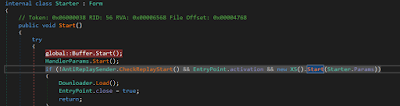 |
| Figure 4: Loader module of the malware |
The "Starter" class contains the routine to load the segments of
the malware. Prior to that, there is the initialization of certain
directories and files utilized to store the accumulated data from
the victim machine. This activity is performed by the primary
instruction "global:: Buffer.Start()", the method is very simple
and easy: a series of folders were created within Windows Special
folders (AppData, Local AppData, Personal, Desktop) along these
lines:
 |
| Figure 5: Creation of folders in the Windows
Special Folders |
From that point forward, the malware extracts the configuration
document and its parameters from the asset named "String0", a
Base64 encoded string and through the following strategy they are
then decoded:
 |
| Figure 6: Routine to extract the
configuration file |
The primary data tag "prog.params" is quickly recovered in the
instruction "HandlerParams.Start()" which can be seen in Figure 4.
Presently, a check of a previous infection is performed before
beginning another one. The instruction
"AntiReplaySender.CheckReplayStart()" (in figure 4) is assigned.
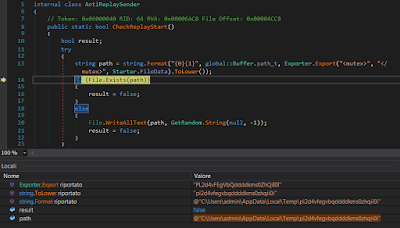 |
| Figure 7: Check of a previous infection |
The malware attempts to discover the id of the mutex. In the event
that the file is available, the malware doesn't execute itself some
other time, else it composes this empty document to sign the
infection is begun. From that point forward, it transforms into the
real vindictive main contained inside the "XS" class, as seen in
figure 4. The primary bit of the code is the following:
 |
Figure 8: Initialization of the mail module |
The first instruction is "Information.Start()" where all the data
about the hardware and software of the host is collected along
these lines:
 |
| Figure 9: Routine for retrieving the
configuration of the victim machine |
It is clearly evident that the malware utilizes both English and
Russian dialects to log the data assembled. From that point onward,
the stealer turns to count and log all the active processes inside
the operative system.
 |
| Figure 10: Routine to extract the process
list |
Now as seen in figure 8, a 'check' on the third parameter is
performed. On the off chance that it is equivalent to one; the
"clippers" module is executed.
 |
| Figure 11: Routine to decode and execute an
embedded component |
As show in the above figure, this code can decode a component
contained inside the "clbase" tag with the AES key stored within
the "update" tag. Be that as it may, in the particular
configuration there is no "clbase" field, so we don't have any
other component to install. The last instruction seen in Figure 8
is "CBoard.Start", which works in the following way:
 |
| Figure 12: Routine to steal clipboard
data |
The subsequent stage is to accumulate all the sensitive data on the
victim machine:
 |
| Figure 14: Detail of the stealing
modules |
The malware steals an immense amount of data:
- Desktop Snapshot
- Sensitive Documents
- Webcam snapshot
- Filezilla credentials
- Pidgin credentials
- Discord Credentials
- Telegram
- Skype
- Steam
- Crypto Currencies
- Chrome chronology
The most fascinating part is that the module "DFiles" instructed to
steal sensitive documents. It begins with looking through the
records with one of the accompanying extensions:
 |
| Figure 15: Routine to search the documents
with specific extensions |
Within the gathered files, the malware searches for the classic
keywords showing that the content of the files conserves some
valuable accreditations. The keywords are the accompanying:
 |
| Figure 16: List of keywords searched within
the documents |
Then the malware proceeds to gather all the data inside a unique
data structure and sends it to the C2 retrieved in another resource
named "connect":
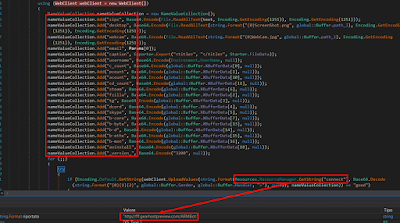 |
| Figure 17: Routine to upload to the C2 the
stolen information |
At long last, it downloads and executes various components from the
Internet. The parameters are recovered similarly observed in the
past segment: a tag named "file" contains the component to
download.
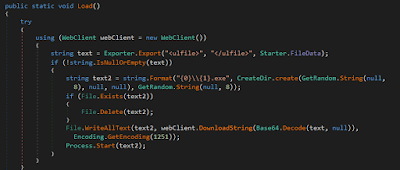 |
| Figure 18: Routine to download other
components from the Internet |
Thus there is no doubt in the fact that Poulight stealer has a
mind-boggling potential to steal delicate data and it ought not to
be disregarded that later on, it may supplant other info stealers
like Agent Tesla, remcos, etc.
In any case, the limitation of the embed is the absence of code
obfuscation and data protection, however, this could be clarified
due to the fact that, possibly, the malware is in its early stages
of development.
Since now that the attackers likely will enhance these features,
therefore, being aware of them is the best step forward for the
users now. RN